Rodri Family: The Spanish Roots Behind a Ballon d’Or Legend

Marta Alizeh

June 12, 2026

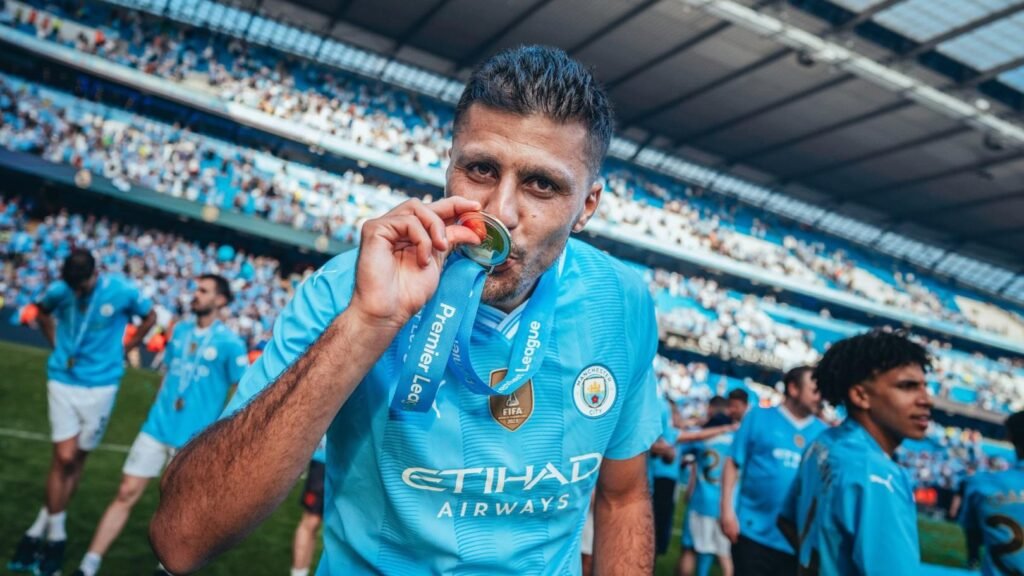
Rodri Family - Rodri celebrating after winning a major football trophy

Introduction

Rodrigo Hernández Cascante – the world knows him simply as Rodri – is one of the most complete footballers of his generation. The 30-year-old defensive midfielder from Madrid has built an extraordinary career at Manchester City and with Spain’s national team, earning the 2024 Ballon d’Or to cement his status as the best player on the planet. Now, after a career-threatening ACL injury, Rodri is captaining Spain at the 2026 World Cup in the United States.

But behind the trophies, the precision passing, and the Champions League-winning goal lies a story rooted in family. The Rodri family – parents Antonio and Elena, and two brothers – shaped every aspect of the man who stands on football’s highest stage. Understanding the Rodri family means understanding the discipline, humility, and quiet determination that have defined his career from suburban Madrid to the Etihad Stadium.


Quick Bio Table

Field Details
Full Name Rodrigo Hernández Cascante
Date of Birth June 22, 1996
Age 30 (turned 30 on June 22, 2026)
Nationality Spanish
Birthplace Madrid, Spain
Height 1.91 m (6 ft 3 in)
Weight 82 kg
Position Defensive Midfielder
Current Club Manchester City
Jersey Number 16
Father Antonio (engineer)
Mother Elena (marketing professional)
Siblings Two brothers
Ethnicity Spanish (White European)
Partner Laura (medical surgeon)

Who is Rodri?

Rodri is a Spanish professional footballer born on June 22, 1996, in Madrid, Spain. He plays as a defensive midfielder for Manchester City in the Premier League and captains the Spain national team. Widely considered the best holding midfielder in world football, Rodri won the 2024 Ballon d’Or, four consecutive Premier League titles with Manchester City, the 2023 UEFA Champions League, and Euro 2024 with Spain. He is now representing Spain at the 2026 FIFA World Cup in the United States after recovering from a serious ACL injury.


Rodri Family Background

The story of the Rodri family begins in the suburbs of Madrid, where Rodrigo Hernández Cascante grew up as the middle child in a household of five. His parents, Antonio and Elena, built a home centred on clear values: education first, hard work always, and football as a passion to be pursued but never at the cost of personal development.

This was not a household of professional athletes. Antonio worked as an engineer; Elena pursued a career in marketing. Their backgrounds gave the family a grounded, middle-class stability that kept Rodri’s feet firmly on the ground even as his football talent began to attract attention at a young age.

What made the Hernández Cascante family distinctive was the framework they placed around their son’s ambitions. Rodri has spoken openly about the deal his parents struck with him: if he wanted to chase a football career, he had to attend university. That contract — unusual for an aspiring professional — would later bear fruit in ways even his parents might not have imagined.

Growing up alongside his two brothers in Madrid, Rodri developed in an environment that balanced competition with support. The family dynamic was tight-knit, with siblings sharing in the journey of a boy who was quietly becoming extraordinary.


Rodri Parents: Antonio and Elena

Rodri’s father, Antonio, is an engineer — a profession defined by logic, problem-solving, and patience. It is hard to watch Rodri orchestrate play from deep midfield, calmly reducing complex game situations to simple choices, without seeing his father’s professional influence reflected in his approach to football.

His mother, Elena, works in marketing — a field built on communication, understanding audiences, and knowing how to position something for maximum impact. Elena’s influence may be harder to map onto the pitch, but it is arguably present in the way Rodri carries himself publicly: deliberate, disciplined, never overexposed.

Together, Antonio and Elena provided emotional scaffolding at critical moments in their son’s career. The most revealing of those moments came when Rodri was a teenager at Villarreal, struggling and close to abandoning his dream altogether.

In his Ballon d’Or acceptance speech, Rodri recalled the moment with raw honesty: “I remember calling my father, crying, feeling like everything was over. I had worked my whole life for this dream, but it felt like it was slipping away. My father told me that if we had come this far, we couldn’t give up now. That conversation changed my mentality completely.”

It is a rare glimpse into a private father-son relationship — and it reveals just how much Antonio’s quiet insistence shaped the man who would one day hold the most prestigious individual trophy in football.

At his Ballon d’Or ceremony, Rodri also made his gratitude explicit: “Today is not a victory for me; it is for Spanish football.” Behind that statement, those who know his story understand, stood the Rodri family.


Does Rodri Have Siblings?

Yes. Rodri has two brothers, making the Hernández Cascante family a household of five — parents Antonio and Elena plus three sons. All three boys grew up together in suburban Madrid, sharing childhood years shaped by their parents’ emphasis on discipline and education.

While his brothers were companions through Rodri’s formative years, it was clear from early on that Rodrigo’s football talent set him apart. He joined local club Rayo Majadahonda as a child before earning a place in Atlético Madrid’s prestigious youth academy — a path that gradually separated him from the everyday rhythms of family life in Madrid.

Rodri has not made his brothers publicly prominent figures, consistent with the low-profile approach to family life he maintains as an adult. Unlike many elite footballers whose siblings become household names, the Rodri family has remained deliberately private. That choice reflects the family’s values as much as anything — grounded, supportive from the background, and content to let Rodrigo’s football speak for itself.


Childhood and Early Life

Rodri’s childhood in Madrid was shaped by three forces: family values, academic pressure, and the magnetic pull of football.

He began his organised football journey at Rayo Majadahonda, a local club in the Madrid suburbs. His talent was evident early enough to earn him a spot in the famous Atlético Madrid youth academy — one of Spain’s most competitive football education systems.

But the Atlético road did not run smoothly. Rodri eventually left the club without breaking into the first team, a setback that tested his resolve and led to the crisis phone call to his father that he would later describe in his Ballon d’Or speech.

The turn came through Villarreal CF, the yellow submarine of La Liga. Rodri joined Villarreal’s youth setup and gradually developed into a professional prospect. During this period, he made an unusual choice for a footballer on the verge of a professional career: he enrolled at Universidad Jaume I in Castellón to study Business Administration and Management.

He continued living in student housing even after signing his first professional contract with Villarreal — a detail that reveals the kind of person the Rodri family had shaped. He graduated with his degree in 2021, completing the academic commitment his parents had made a condition of pursuing football.

From Villarreal, his performances attracted the attention of Atlético Madrid’s first team. He joined the Rojiblancos as a senior player under Diego Simeone, the platform that would ultimately bring him to the notice of Pep Guardiola at Manchester City.


Family Influence on Rodri’s Career

The Rodri family’s influence on his career is not coincidental or indirect — it is structural. The values instilled by Antonio and Elena created habits and a mindset that directly translated into professional excellence.

The education requirement is the clearest example. By insisting Rodri attend university, his parents ensured he developed a broader intellectual framework than most footballers carry into their careers. Rodri has described how studying Business Administration gave him perspective — an understanding that football, however consuming, is one part of a larger life.

That perspective is visible in the way he plays. Rodri’s style is not flash or instinct-driven; it is analytical, patient, and intelligent. He reads games the way an engineer reads blueprints. He positions himself not for the next moment but for the moment after that.

His father’s intervention at Villarreal — refusing to let him quit — illustrates a second family lesson: resilience is not innate, it is cultivated. Every time Rodri has faced adversity on the pitch — the early struggles at Atlético’s youth academy, the difficult first months at Villarreal, the ACL injury he suffered against Arsenal in September 2024 — he has responded with patience and determination. Those responses were practiced first at home.

His partner, Laura, a medical surgeon he met while studying at Villarreal’s student residence during his U21 years, also reflects the values his family instilled: grounded, professional, and outside the football bubble. The Rodri family created a man who gravitates toward substance over spectacle.


Career Highlights That Honour His Family’s Investment

The trophies Rodri has won are well-documented, but viewed through the lens of his family story, they carry added weight.

In July 2019, Manchester City paid a then-club record of £62.8 million to bring him from Atlético Madrid — a figure that would have been unimaginable to the middle-class Madrid family that started this journey.

Under Pep Guardiola at the Etihad Stadium, Rodri became the heartbeat of one of football’s most dominant clubs. He won four consecutive Premier League titles from 2020–21 through 2023–24 and scored the winning goal in the 2023 UEFA Champions League final against Inter Milan — the goal that completed Manchester City’s historic treble.

In summer 2024, he helped Spain win Euro 2024 with La Roja, their first major international trophy since 2012.

In October 2024, Rodri was awarded the Ballon d’Or — the first Manchester City player ever to receive the honour and the first Spaniard since Luis Suárez in 1960. He dedicated the victory not to himself but to Spanish football.

Then, on September 22, 2024, in a 2–2 draw with Arsenal, Rodri suffered a severe ACL and meniscus injury to his right knee — a blow that ended his 2024–25 season almost before it began. In a candid interview during his recovery, he admitted fears about whether he would return to the same level. He made his comeback for Manchester City in their final home game of the season against Bournemouth on May 20, 2025, making just four league starts before the campaign ended. Manchester City finished third in the Premier League that season, their worst finish under Guardiola. Pep Guardiola said Rodri “changed the game” on return and “proved in 45 minutes that he is the best in his position.”

A hamstring problem then sidelined Rodri for nine Premier League games in November and December 2025. He returned again and rebuilt his fitness across the second half of the 2025–26 season. By summer 2026, he had earned the captaincy of Spain’s World Cup squad. It is the kind of long-game approach his family built into him long before any professional club did.

At the 2026 World Cup in the United States, Rodri is captaining Spain and anchoring their 4–3–3 formation from deep. Spain drew 0–0 with Cape Verde on June 15 in a surprise group result, then beat Saudi Arabia 4–0 on June 21. Their final group game is against Uruguay on June 26 in Guadalajara. Spain lead Group H.

Rodri with the Ballon d'Or trophy - Rodri Family


Interesting Facts About the Rodri Family

  • The Rodri family struck a deal when Rodrigo was young: pursue football, but attend university. He honoured that deal, graduating with a Business Administration degree from Jaume I University in 2021.
  • Rodri’s father, Antonio, works as an engineer — a profession that may have influenced Rodri’s highly analytical, systems-driven playing style.
  • His mother, Elena, works in marketing — a field centred on communication and positioning, qualities visible in how Rodri manages his public profile.
  • Rodri’s partner, Laura, is a medical surgeon he met while living in student residence at Villarreal — a relationship that began long before his fame.
  • The Hernández Cascante family are known for being deliberately private, rarely appearing in media coverage despite Rodri’s global profile.
  • Rodri does not use social media — no Instagram, no X (formerly Twitter), no Facebook — a choice that reflects the family’s preference for grounded, private living.
  • After winning the Ballon d’Or, Rodri thanked his parents in his acceptance speech, recalling the moment his father refused to let him quit football as a teenager.

Unknown Facts About the Rodri Family

  • Rodri’s two brothers have never been named publicly, consistent with the family’s low-profile approach to privacy.
  • Rodri continued living in student housing at Villarreal even after signing his first professional contract — an unusual choice driven by family values rather than financial necessity.
  • His parents did not come from a footballing background; neither Antonio nor Elena was a professional athlete, making Rodri’s rise entirely self-generated within a non-sporting household.
  • The crisis call to his father at age 17 — when Rodri was ready to quit football — is one of the most significant undiscussed moments in his career. That single conversation may have been the difference between retirement and a Ballon d’Or.
  • Rodri’s academic path was not a PR exercise; he sat real university exams between matches and training sessions throughout his early professional career.
  • The Rodri family has never sought visibility through celebrity culture, brand partnerships, or media exposure — a rarity in elite football circles.

You may also enjoy reading about these football families:


Sources


FAQ Section

Who are Rodri’s parents? Rodri’s parents are Antonio, an engineer, and Elena, a marketing professional. Both were raised in Spain and played a central role in Rodri’s upbringing, insisting he pursue education alongside his football career.

Does Rodri have siblings? Yes. Rodri has two brothers. He grew up as one of three sons in the Hernández Cascante household in Madrid. His brothers have maintained a private profile and are not publicly named.

What is Rodri’s nationality? Rodri is Spanish. He was born in Madrid, Spain, on June 22, 1996, and represents La Roja — the Spain national football team — at international level.

Where was Rodri born? Rodri was born in Madrid, Spain, specifically in the suburban areas of the city. He began his football career locally before joining Atlético Madrid’s youth academy.

Why is Rodri famous? Rodri is one of the world’s best defensive midfielders and the 2024 Ballon d’Or winner. He has won four Premier League titles with Manchester City, the 2023 UEFA Champions League (scoring the winning goal in the final), and Euro 2024 with Spain. He is now captaining Spain at the 2026 FIFA World Cup.

Which club does Rodri play for? Rodri plays for Manchester City in the Premier League, where he has been the first-choice defensive midfielder since joining from Atlético Madrid in July 2019 for a club-record £62.8 million.

Has Rodri won the Ballon d’Or? Yes. Rodri won the 2024 Ballon d’Or in October 2024, becoming the first Manchester City player to win the award and the first Spaniard to do so since Luis Suárez in 1960.

Is Rodri married? Rodri is in a long-term relationship with Laura, a medical surgeon he met while living in student residence during his time at Villarreal. The couple have maintained a very private profile.


Conclusion

The story of the Rodri family is not a story about football. It is a story about values — the kind of values that, once established in childhood, become the foundation for everything that follows.

Antonio and Elena Hernández Cascante raised their three sons in suburban Madrid with two non-negotiable principles: work hard and get educated. When their middle son showed signs of becoming a special footballer, they did not simply clear the path for him. They added a condition: university first, alongside football, always.

That condition — and the resilience it built — is why Rodri did not quit when things got hard at Villarreal. It is why he spent years developing patiently rather than demanding fame. It is why, when he finally stood on the stage at the Ballon d’Or ceremony in Paris and heard his name called, he dedicated the moment not to himself but to an entire country.

The trophies, the titles, the Champions League goal, the Ballon d’Or, and now a first World Cup as Spain’s captain — all of it traces back to the Rodri family home in Madrid, to a father who told a crying teenager not to give up, and to parents who understood that the best foundation for any career is character.

Article last substantively updated: June 24, 2026.

Leave a Comment