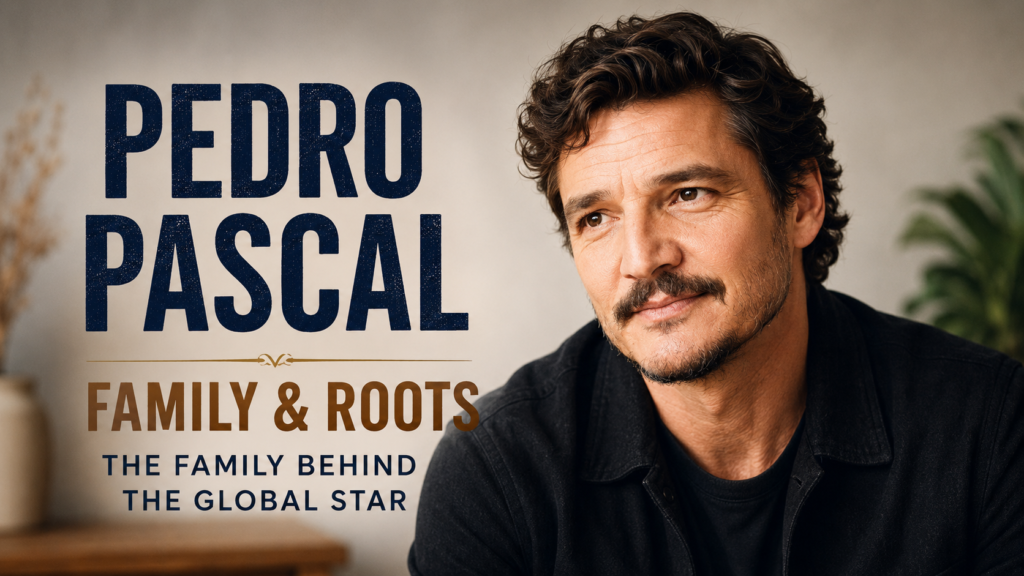
Pedro Pascal was nine months old when his parents fled Chile with him, hiding inside the Venezuelan embassy in Santiago for six months before a foreign government granted them asylum. That single fact, verified across biographical reporting and Pascal’s own interviews, is the real starting point of the Pedro Pascal family story. It is also the most overlooked one. Long before he played a father figure protecting a lost child in The Mandalorian and The Last of Us, Pedro Pascal was the child being protected during his own family’s escape.
Quick Bio Table
| Field | Details |
|---|---|
| Full Name | José Pedro Balmaceda Pascal |
| Date of Birth | April 2, 1975 |
| Age | 51 |
| Nationality | Chilean and American |
| Birthplace | Santiago, Chile |
| Height | Not publicly verified |
| Role | Actor |
| Current Affiliation | Recurring roles across Disney+, HBO and Marvel Studios productions |
| Jersey Number | Not applicable |
| Recent Work | The Fantastic Four: First Steps (2025); The Mandalorian and Grogu (May 2026); Avengers: Doomsday (due December 18, 2026) |
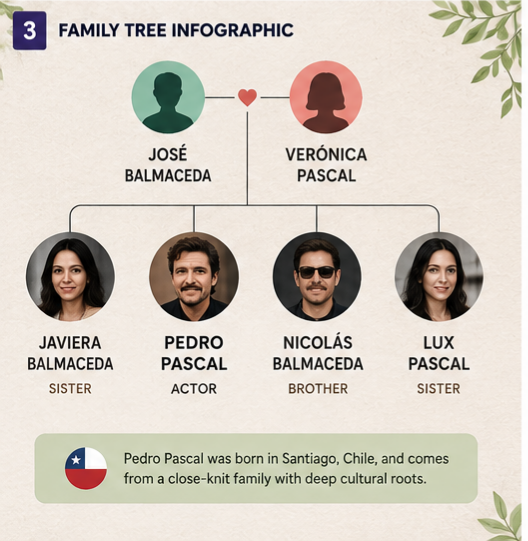
| Parents | Verónica Pascal Ureta (1953 to 2000), child psychologist; José Balmaceda Riera (born 1948), reproductive endocrinologist |
| Siblings | Javiera Balmaceda (older sister), Nicolás Balmaceda Pascal (younger brother), Lux Pascal (younger sister) |
| Ethnicity | Chilean, of Castilian-Basque aristocratic descent |
| Religion | Not publicly disclosed |
| Article last substantively updated | July 3, 2026 |
Who is Pedro Pascal?
Pedro Pascal, born José Pedro Balmaceda Pascal on April 2, 1975, in Santiago, Chile, is a Chilean and American actor known for playing protective, often adoptive father figures. He starred as Oberyn Martell in Game of Thrones, Javier Peña in Narcos, Din Djarin in The Mandalorian, and Joel Miller in The Last of Us, earning a SAG Award and a spot on Time’s 100 most influential people in 2023.
Pedro Pascal Family Background
Pedro Pascal’s family history began under a military dictatorship, not in Hollywood. He was born in Santiago two years after General Augusto Pinochet overthrew the democratically elected government of President Salvador Allende. Both of his parents were listed as enemies of the state by the new regime.
When Pascal was nine months old, the family fled Chile. They spent six months seeking refuge inside the Venezuelan embassy in Santiago before receiving political asylum in Denmark. From Denmark, the family eventually resettled in the United States, where Pascal was raised in San Antonio, Texas, before the family relocated to Orange County, California, when he was eleven.
That childhood displacement runs through three continents before puberty: South America, Scandinavia, then North America. It is a level of forced movement rarely matched among his Hollywood peers, and it happened entirely because of his parents’ politics under Pinochet, not by choice.
Pascal’s family also carries a documented political lineage that predates the dictatorship. He is the great-nephew of Laura Allende, a politician and the sister of President Salvador Allende himself, and the second cousin of Andrés Pascal Allende, a former leader of the Movement of the Revolutionary Left and a prominent figure in the Chilean resistance to Pinochet. The connection was personal, not distant. After the 1973 coup, the family sheltered Andrés Pascal Allende while the regime’s secret police hunted him, and he later told Chilean outlet La Tercera he remembered playing with Pedro as a small child during that period.
Pedro Pascal Parents
Pedro Pascal’s mother was Verónica Pascal Ureta, a Chilean child psychologist born in 1953. His father is José Balmaceda Riera, a reproductive endocrinologist born in 1948. Both were named enemies of the Pinochet state, which is the documented reason the family fled Chile when Pascal was an infant.
The family’s story took a second sharp turn in 1995. Pascal’s parents returned to Chile that year after his father, Dr. José Balmaceda, was accused of stealing fertility patients’ eggs and embryos and implanting them in other women without their knowledge or consent. Pascal, then in his early twenties and studying at NYU’s Tisch School of the Arts, stayed behind in the United States to continue pursuing acting while his parents went back to the country they had once fled.
His mother, Verónica, died in 2000, in her mid-forties. Some credible reports, including Esquire, place her death in early 1999, so sources differ on the exact date. Pascal has spoken about her death publicly and with unusual candor for a private person. In a 2020 interview with People, he said, “She was always incredibly supportive, never a stage mom. I always felt like she knew something that I didn’t. None of [my success] would be real if it weren’t for her.” He has also told Chilean outlet La Tercera, “She was the love of my life. I think about her every day. I live for her even though she’s gone, and that gives me purpose.”
After her death, Pascal began using her maiden name, Pascal, as his professional surname instead of his father’s name, Balmaceda. He has said the choice honored his mother and also solved a practical problem: American audiences and casting rooms consistently struggled to pronounce Balmaceda. “My mom named me Pedro,” he has said. “So, the decision was made to call me Pedro Pascal, a name that fits me more than any other.”
Does Pedro Pascal Have Siblings?
Yes, Pedro Pascal has three siblings: an older sister, a younger brother and a younger sister. His older sister, Javiera Balmaceda, is a film and television producer who serves as Head of Local Originals for Amazon Studios across Latin America, Canada and Australia. She produced “Argentina, 1985,” the only Latin American film nominated for the Academy Award for Best International Feature in 2023, and she accompanied Pascal to that year’s Oscars as his date.
His younger brother, Nicolás Balmaceda Pascal, has stayed almost entirely out of the public eye. He is a doctor. Lifestyle outlets report his specialty as pediatric neurology, though no primary source confirms that detail, so it should be read as reported rather than settled fact. Pascal has spoken about him warmly in interviews, at one point describing him as the real superhero in the family for choosing a career built around helping children.
His younger sister, Lux Pascal, is an actress who graduated from Juilliard with an MFA in acting in May 2023. She appeared in The Prince (2019), Invisible Heroes (2019) and the Chilean drama series Los 80, and landed her first leading film role in Miss Carbón (2025), playing the first woman miner in Patagonia. In 2021, Lux came out as transgender, a step Pedro has publicly and consistently supported.
Childhood and Early Life
Pedro Pascal’s childhood was shaped less by a fixed hometown than by repeated relocation. After the family’s exile from Chile and asylum in Denmark, he grew up in San Antonio, Texas, and then Orange County, California, from age eleven onward. By the time he was eight, the family regularly traveled back to Chile to visit his 34 cousins, keeping a connection to the country his parents had fled.
He pursued acting early, training at the Orange County School of the Arts, where he graduated in 1993. He then studied at New York University’s Tisch School of the Arts, graduating in 1997. His parents’ return to Chile in 1995, following the fertility fraud accusations against his father, meant Pascal finished his training essentially without his immediate family nearby in the United States.
The years that followed his graduation were financially brutal, and Pascal has never minimized that. He took small roles on stage and television while working as a waiter to cover rent, and he has said he was fired from restaurant jobs “often, upwards of, I don’t know, maybe close to 10 times.” During one particularly hard stretch, with less than seven dollars in his bank account and no way to afford medical care, a residual check from an early guest role on Buffy the Vampire Slayer arrived and kept him financially afloat. His close friend, actress Sarah Paulson, also gave him her per diem money during lean periods so he could afford food.
During this period, Pascal joined New York City’s LAByrinth Theater Company, a members-based ensemble that became his main creative home while television roles stayed small. He won the Los Angeles Drama Critics Circle Award and a Garland Award for his stage role in Orphans at the International City Theater. In 2005, he made his feature film debut in Julia Solomonoff’s Sisters, still billed under his birth surname, Balmaceda, years before he adopted his mother’s name professionally. He later made his Broadway debut in 2019, playing Edmund in a revival of King Lear, a Shakespearean role built around a father, a kingdom and warring siblings, themes that echo, whether intentionally or not, through his own family’s story.
Family Influence on Career
Pedro Pascal’s family history maps onto his acting career with unusual precision. He is best known today for playing protective father figures: Din Djarin, who risks everything to shield an orphaned child in The Mandalorian, and Joel Miller, who does the same for an orphaned teenager in The Last of Us. Both roles built his stardom on the image of a man who protects a displaced child from a dangerous world. That image now spans theaters too, with The Mandalorian and Grogu released in May 2026 and Avengers: Doomsday, in which Pascal plays Reed Richards, due December 18, 2026.
That image isn’t a coincidence set against his own biography. Pascal was that displaced child once, carried out of Chile at nine months old by parents fleeing a dictatorship, sheltered for six months in a foreign embassy, then raised across three countries before he turned twelve. The forced instability of his own early life gives his most famous roles a layer of lived authenticity that casting alone can’t manufacture.
His mother’s influence shows up just as directly, though in a different register. Verónica Pascal’s death reshaped his professional identity down to the name on his contracts. Every credit that reads “Pedro Pascal” instead of “Pedro Balmaceda” is, by his own account, a tribute to her. Few actors carry a parent’s memory that literally into their public-facing career.
His sister Javiera adds a third, less discussed thread. The two grew up going to the movies together because it was cheaper than paying for a babysitter, according to family reporting around their joint appearance at the 2023 Oscars. That shared habit, born out of financial necessity rather than industry ambition, gave both siblings an early, sustained exposure to film as a shared family language, one sibling eventually acting in front of the camera and the other producing behind it.
The family’s political history adds a fourth layer that rarely makes it into casting profiles. Growing up as the relative of figures central to Chile’s resistance against Pinochet gave Pascal a family script built around protecting people against forces stronger than them. It’s not a stretch to trace a line from that inherited history to a career built almost entirely on playing men who shield the vulnerable, whether that’s a bounty hunter guarding a child across a hostile galaxy or a smuggler protecting a teenager across a ruined country.
Interesting Facts About Pedro Pascal’s Family
- Pascal is the great-nephew of Laura Allende, sister of former Chilean president Salvador Allende, and the second cousin of Andrés Pascal Allende, a leading figure in the Chilean resistance to Pinochet.
- His family sheltered Andrés Pascal Allende after the 1973 coup, and Andrés later recalled playing with a very young Pedro while hiding from the secret police.
- His paternal grandmother, Juanita Riera Bauzá, was born in Palma de Mallorca, Spain, and was the sister of Fernando Riera, a Chilean professional footballer and national team coach.
- He is the seventh great-grandson of Mateo de Toro Zambrano, tying his family to Chile’s Alessandri, Allende and Balmaceda political dynasties.
- All three of his siblings work in fields connected to storytelling or care: Javiera in film production, Lux in acting, and Nicolás in medicine.
- He and his older sister Javiera attended the 2023 Academy Awards together, where her film “Argentina, 1985” was in contention.
- His sister Lux Pascal landed her first leading film role in Miss Carbón (2025), released the same year Pedro led Marvel’s The Fantastic Four: First Steps.
- He changed his professional surname from Balmaceda to Pascal, his mother’s maiden name, after her death in 2000.
Frequently Asked Questions
Who are Pedro Pascal’s parents?
His mother was Verónica Pascal Ureta, a Chilean child psychologist who died in 2000. His father is José Balmaceda Riera, a reproductive endocrinologist. Both were declared enemies of the Pinochet regime, which forced the family to flee Chile in 1975.
Does Pedro Pascal have siblings?
Yes. He has an older sister, Javiera Balmaceda, a film and television producer at Amazon Studios, a younger brother, Nicolás Balmaceda Pascal, a doctor, and a younger sister, actress Lux Pascal.
What is Pedro Pascal’s family background?
His family fled Chile under the Pinochet dictatorship when he was nine months old, received asylum in Denmark, and eventually settled in the United States, where Pascal was raised in Texas and California.
Where was Pedro Pascal born?
Pedro Pascal was born in Santiago, Chile, on April 2, 1975.
What nationality is Pedro Pascal?
Pedro Pascal holds both Chilean and American nationality, a result of his family’s political exile from Chile and eventual resettlement in the United States.
Why is Pedro Pascal famous?
Pedro Pascal is famous for playing Oberyn Martell in Game of Thrones, Javier Peña in Narcos, Din Djarin in The Mandalorian, and Joel Miller in The Last of Us, roles that built his reputation for portraying protective father figures.
Why does Pedro Pascal use his mother’s surname?
After his mother Verónica Pascal’s death in 2000, he began using her maiden name, Pascal, professionally, both to honor her memory and because American audiences struggled to pronounce his father’s surname, Balmaceda.
Is Pedro Pascal related to Chilean political figures?
Yes. He is the great-nephew of Laura Allende, sister of former president Salvador Allende, and the second cousin of Andrés Pascal Allende, a figure in the Chilean resistance movement.
Conclusion
Pedro Pascal’s family didn’t just support his career from a distance. It shaped the roles that made him famous. A childhood spent fleeing Pinochet’s Chile, moving through Denmark, Texas and California, built the same protective instinct audiences now recognize in Din Djarin and Joel Miller. His mother’s death changed the name on his call sheets. His sister’s career now runs parallel to his own, on opposite sides of the camera. As of July 3, 2026, Pascal has already released The Mandalorian and Grogu this year and has Avengers: Doomsday due in December. This article reflects information as of July 3, 2026, and will be substantively updated, not just date-stamped, as new verified details emerge about the Pedro Pascal family.
Related reading: explore Isabela Merced’s family, Xochitl Gomez’s family, and Mikey Madison’s family for more on the households behind Hollywood’s rising Latin American and young acting talent.