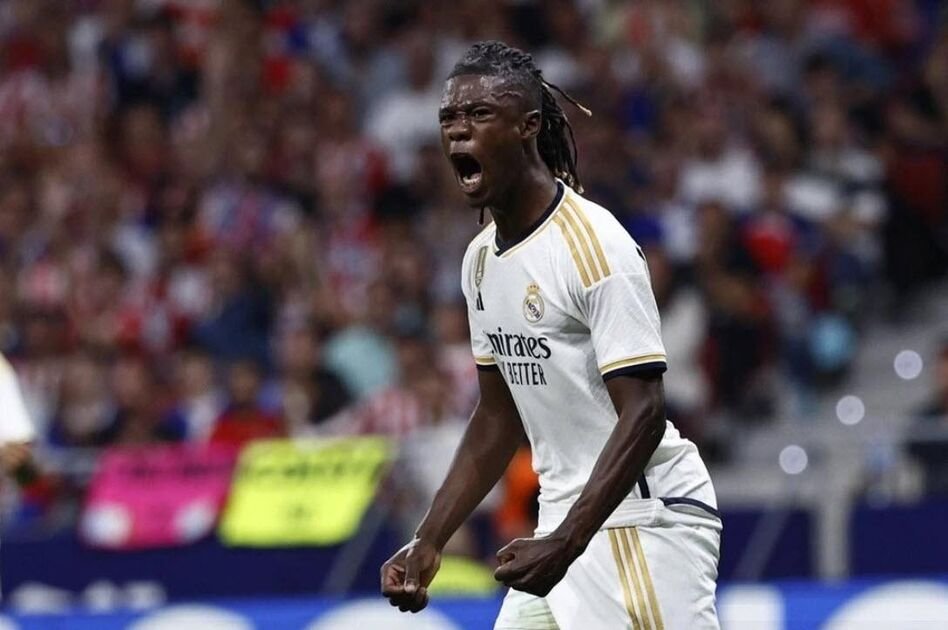
Most footballers’ family stories begin on a Sunday-league pitch or in a parent’s living room. Eduardo Camavinga’s begins in a refugee camp.
The Eduardo Camavinga family arrived in Europe with almost nothing — Congolese parents who had fled civil war, a baby born in Cabinda, Angola, and the determination to start again in a small Breton town called Fougères. Two decades later, the same family has watched their son lift the UEFA Champions League trophy with Real Madrid and play in a World Cup final for France.
The journey from a Cabinda refugee camp to the Santiago Bernabéu is the kind of story that rarely survives the modern football publicity machine intact. But Camavinga has spoken about it openly and consistently — the war his parents escaped, the house fire that destroyed everything when he was 10, and the family of eight that built the foundation for one of the most composed young midfielders in world football.
This is what is publicly verified about the Eduardo Camavinga family.

📋 Eduardo Camavinga — Quick Family Bio Table
| Detail | Information |
|---|---|
| Full Name | Eduardo Celmi Camavinga |
| Date of Birth | 10 November 2002 |
| Age | 23 years old |
| Birthplace | Cabinda, Angola (refugee camp in Miconge) |
| Nationality | French (acquired 5 November 2019) |
| Ethnic Heritage | Congolese (Republic of the Congo / DR Congo) |
| Height | 1.82 m (6 ft 0 in) |
| Position | Central Midfielder / Left-back |
| Current Club | Real Madrid |
| Jersey Number | 6 |
| Father | Celestino Camavinga |
| Mother | Sofia Simão |
| Siblings | Five — six children in total. Known brothers: Sebastião (elder) and Célio (younger) |
| Raised In | Fougères, Brittany, France |
| Contract Until | 30 June 2029 |
| Religion | Not publicly disclosed |
Who Is Eduardo Camavinga? (Featured Snippet)
Eduardo Camavinga is a French professional footballer of Congolese descent who plays as a central midfielder for Real Madrid and the France national team. Born on 10 November 2002 in a refugee camp in Cabinda, Angola, to parents Celestino Camavinga and Sofia Simão, he moved to France at the age of two and grew up in the Breton town of Fougères.
Eduardo Camavinga Family Background
The Camavinga family story does not begin in France. It begins in the Republic of the Congo, where Eduardo’s parents lived before the outbreak of civil war in the late 1990s. Fleeing the conflict, Celestino Camavinga and Sofia Simão crossed into the Cabinda exclave of Angola — a small territory wedged between the two Congos — and settled in a refugee camp in the area of Miconge.
It was there, on 10 November 2002, that Eduardo Celmi Camavinga was born.
The family did not stay in Cabinda for long. When Eduardo was around two years old — roughly 2004 — they migrated again, this time to France. They settled first briefly in Lille, before relocating to a more permanent home in Fougères, a town of just over 20,000 people in the Brittany region of north-western France.
Fougères was not a stop-over. It became home. The family rebuilt their lives there: a household of two parents and six children, in a quiet provincial town a long way from both Cabinda and Paris. Eduardo received French citizenship on 5 November 2019, just five days before his 17th birthday.
For another European footballer whose family migration shaped his early life, you may enjoy our Endrick football journey profile — though Endrick’s path from Brazil to Real Madrid took a very different shape.
Eduardo Camavinga Parents
Celestino Camavinga — The Father
Celestino Camavinga is described in multiple sources as Angolan-Congolese — Congolese in heritage, born in Cabinda. He is the figure whose decisions shaped the family’s geography. It was Celestino who chose to leave the war behind, who chose Fougères when many Congolese migrants of his generation gravitated towards the Paris suburbs, and who took on a series of demanding manual jobs to support a household of eight in a new country.
According to multiple family-bio sources, Celestino worked factory and agricultural jobs in and around Fougères to provide for the family. In a country where new immigrants often struggle to find footing, that working-life portrait — long shifts, modest pay, six children at home — matters. It explains why Eduardo’s interviews so often return to gratitude rather than ambition.
Celestino has remained largely outside of the football media spotlight. Spanish outlet Marca once published a piece titled “The prophecy of Camavinga’s father” documenting how Celestino predicted his son’s success early — but interviews with him remain rare, by his own apparent choice.
Sofia Simão — The Mother
Eduardo’s mother, Sofia Simão, was also born in Cabinda, and shares the Congolese refugee background of her husband. Her surname — Simão — reflects the Portuguese-speaking lineage common in the Cabinda region, which has Lusophone roots through Angola’s Portuguese colonial history.
Public details about Sofia are deliberately sparse. She has not given media interviews and has no public presence on social media. What is documented is that she has been a quiet, central force in the household — managing six children, settling in a foreign country, and providing the emotional ballast that Eduardo has repeatedly credited in his interviews.
When Camavinga signed his first professional contract with Rennes, and again when he moved to Real Madrid, his mother was reportedly the first person he wanted to call. That detail keeps recurring in profiles. It is the version of family his story is built on — not glamorous, not photographed, but absolutely present.
For another quiet, low-profile family that has been instrumental to a young footballer’s rise, see our Warren Zaïre-Emery family profile.
Eduardo Camavinga Siblings
Eduardo Camavinga is one of six children. He has five siblings in total.
Of the five, two brothers are publicly identified in football media:
Sebastião Camavinga — Eduardo’s elder brother. Sebastião reportedly works as a professional barber and has been documented cutting the hair of multiple Real Madrid players, including Eduardo himself. He has occasionally been visible at major Real Madrid matches and was widely photographed at the 2023 UEFA Champions League final.
Célio Camavinga — Eduardo’s younger brother. Célio gained unexpected media attention at the 2023 Champions League final when many outlets initially mistook him for Eduardo’s son — he was around seven years old at the time. The two brothers’ close relationship has been frequently noted by Spanish and French sports media.
The remaining siblings have not been publicly identified by name. The family appears to have made an active decision to keep them out of football media coverage, and Eduardo himself rarely names them in interviews. What he has said, repeatedly, is that the six siblings grew up tight — bonded by the unusual circumstances of a refugee family rebuilding life in provincial France.
You can read about another close-knit family that prioritises sibling bonds in our Pedri upbringing and family support profile.
Childhood and Early Life
Camavinga’s childhood is the part of his story that fans most often hear about, and it deserves to be told carefully.
After arriving in France around age two, the family settled in Fougères. Eduardo grew up bilingual, eventually trilingual — French at school, Portuguese at home, and later Spanish at Real Madrid. He attended local schools, and like many Breton kids, his first organised sport was not football. He started with judo before switching focus.
At age seven, he joined his first football club, Drapeau-Fougères, a small local outfit where his talent quickly stood out. By 2013, when he was eleven, Stade Rennais — Brittany’s flagship Ligue 1 club — had brought him into their youth academy.
That same year, 2013, the Camavinga family home was destroyed by a fire. The blaze destroyed nearly all the family’s belongings. Eduardo has spoken about that moment in interviews more than once, and his framing has been remarkably consistent: rather than treating the fire as a defining trauma, he has said it became fuel — a reason to push harder in football, so he could one day rebuild a stable life for his parents and siblings.
That single sentence reframes how much of his career then unfolded.
By 2018, at age 15, he was in Rennes’ second team. On 6 April 2019, aged 16 years, 4 months and 27 days, he made his Ligue 1 debut for Rennes — becoming the club’s youngest-ever first-team player. Months later, on 7 July 2020, he completed his Baccalauréat ES (the French economics-and-social-sciences baccalaureate) — a detail he is unusually proud of, because his mother insisted his schooling come first even as his football career exploded.
For another European footballer who balanced education and an early professional breakthrough, see our Florian Wirtz development story profile.
Family Influence on Football Career
Three things stand out about how the Camavinga family has shaped his footballing life.
1. The refugee story is not a backstory. It is a present-tense reality that informs how Camavinga plays and behaves. Coaches at Rennes and Real Madrid have repeatedly described him as unusually grounded, unusually mature, and unusually grateful — qualities that are difficult to coach into a teenager. They come from the home he grew up in.
2. The 2013 fire became his stated motivation. After moving to Real Madrid for €30–31 million in 2021, one of the first things Camavinga did with his earnings was reportedly buy his parents a new family home. The full circle is not symbolic. It is the literal goal he set himself at age 10 after watching the family’s possessions burn.
3. His mother’s insistence on education has shaped his composure. Players who pass their Bac while breaking Ligue 1 records are rare. Players who credit their mother for that achievement in public interviews are rarer still. That cultural anchor — education as a non-negotiable, even at the peak of a youth-academy career — has carried into how Camavinga handles press scrutiny, big matches, and setbacks. He has dealt with injury and Real Madrid tactical reshuffles in 2025–26 with a maturity that, at 23, is conspicuous.
The Camavinga family also gave him something subtler: language. Growing up speaking Portuguese at home meant he arrived in Madrid able to integrate with the dressing room’s Spanish and Brazilian players faster than most foreign signings. That is a small, often-overlooked family gift.
For another young footballer whose family hardship became fuel for his career, see Gavi family parents and sister sacrifices.
The Cabinda Connection
It is worth pausing on Cabinda specifically, because it is unusual.
Cabinda is an Angolan exclave — a small territory of around 7,000 square kilometres, separated from the rest of Angola by a strip of the Democratic Republic of the Congo. It sits between the Republic of the Congo (Brazzaville) to the north and the DRC to the south. Throughout the 1990s and early 2000s, it was a destination for refugees fleeing conflicts in both Congos.
Both of Eduardo’s parents were born in Cabinda. Both have Congolese background. The geography of his origin story is not symbolic — it is a literal map of African civil war, post-colonial Portuguese-speaking borders, and the specific oil-rich enclave that became a refuge for people displaced from Brazzaville.
Few elite footballers can point to a single town that means as much to their family history as Cabinda means to the Camavingas. It is part of why Eduardo’s identity has been reported as so layered: French by citizenship, Congolese by heritage, Angolan by birthplace, Portuguese by language at home.
Interesting Facts About the Eduardo Camavinga Family
- Eduardo was born in a refugee camp in Miconge, Cabinda, Angola, after his parents fled civil war in DR Congo
- His full birth name is Eduardo Celmi Camavinga
- The family of six children moved from Angola to France when he was around two years old
- They settled briefly in Lille before making Fougères, Brittany their permanent home
- In 2013, the family home was destroyed by fire, an event Eduardo has called the turning point in his football ambition
- He received French citizenship on 5 November 2019, just before his 17th birthday
- His elder brother Sebastião is a professional barber who has cut hair for Real Madrid players
- His younger brother Célio was mistaken for Eduardo’s son at the 2023 Champions League final
- The family speaks Portuguese at home, which helped Eduardo integrate quickly at Real Madrid
- He passed his French Baccalauréat ES in July 2020 — at the same time as breaking Ligue 1 records
- He briefly trained in judo before switching focus to football at age seven
- His religious affiliation has never been publicly disclosed in interviews or verified profiles
❓ Frequently Asked Questions
Who are Eduardo Camavinga’s parents? His father is Celestino Camavinga and his mother is Sofia Simão. Both have Congolese heritage and were born in Cabinda. They fled the civil war in the Republic of the Congo and lived in a refugee camp before emigrating to France.
Where was Eduardo Camavinga born? He was born on 10 November 2002 in a refugee camp in the Miconge area of Cabinda, Angola — an Angolan exclave between the two Congos. His family moved to France when he was around two years old.
How many siblings does Eduardo Camavinga have? He has five siblings — there are six children in the Camavinga family in total. The two publicly identified brothers are Sebastião, his elder brother who works as a professional barber, and Célio, his younger brother.
What is Eduardo Camavinga’s nationality? He is French. He obtained French citizenship on 5 November 2019. He is also Angolan by birth and of Congolese heritage through his parents.
What is Eduardo Camavinga’s ethnicity? Camavinga has Congolese heritage. Both of his parents are Congolese, with origins in the Republic of the Congo. His father has also been described in some sources as Angolan-Congolese, having been born in the Cabinda region of Angola.
What is Eduardo Camavinga’s childhood story? He was born in a refugee camp in Cabinda and moved with his family to Fougères, Brittany at age two. In 2013, when he was 10, the family home was destroyed by a fire. He has called this event the moment that motivated him to pursue football professionally.
Where did Eduardo Camavinga grow up? He grew up primarily in Fougères, a town in the Brittany region of north-western France, after a brief initial period in Lille.
Did Eduardo Camavinga’s family suffer a house fire? Yes. In 2013, when Eduardo was around 10 years old, the family home in Fougères was destroyed by fire, taking most of the family’s possessions. Eduardo has cited this event as a key motivation in his career.
Conclusion
The Eduardo Camavinga family story is one of the few in modern elite football that genuinely changes the way you watch the player. Knowing that the composed central midfielder operating at the Santiago Bernabéu was born in a refugee camp in Cabinda, that his parents fled a civil war to get him there, that his family rebuilt after a house fire when he was ten — these are not background details. They are the lens.
What is also striking is how little the family themselves have leveraged any of this. There is no Camavinga family reality show, no monetised migration narrative, no parents-as-managers controversy. There is a father who worked factory and farm jobs, a mother who insisted her son finish his Baccalauréat, an elder brother who quietly cuts Real Madrid players’ hair, and a younger brother who looks so much like Eduardo people mistake them for father and son.
Whatever happens next in Eduardo Camavinga’s career — more Champions League titles with Real Madrid, a long international future with France, perhaps the captaincy of Les Bleus one day — the Eduardo Camavinga family will almost certainly stay exactly where they have always been: in Fougères, on a quiet street in Brittany, far from the noise, quietly keeping their son grounded.
External references: Wikipedia, Real Madrid CF official site, BBC Sport and Spanish outlets including Marca and Cadena SER provided the family-related details cited in this article.